When AI Eats IP
TL;DR [show]
In September 2026 OpenAI announced that roughly 10,000 agents running for 88 hours had proved finite-time blow-up for a forced version of the Navier-Stokes equations. About twelve hours earlier, NYU mathematician Tristan Buckmaster had posted his own results with Levent Alpöge, an Anthropic employee, from a year-long collaboration run largely inside commercial AI tools, including OpenAI's Codex, with training opted out. He alleges OpenAI's effort drew on their unpublished work and that OpenAI pressed to drop Alpöge from authorship; OpenAI denies seeing any of it. This piece does not referee the dispute. It argues that the exposure is identical whichever side is right. The one instrument Buckmaster had, the training opt-out, did not settle the question: OpenAI's first statement said it could not rule out that de-identified data derived from his usage helped improve its models, and over five days the assurance narrowed to 'no user inputs past July 3rd', a line drawn, investigated and announced by the party he suspects, which leaves ten months of the collaboration on the unaddressed side. Nothing in the record is a legal filing, because what he had was a direction of attack sitting in a vendor's session logs, which is not a thing intellectual-property law knows how to protect. The operator consequence is that vertical integration at the tooling layer makes your supplier a participant in your market, and every health system or airline pasting unshipped work into a coding agent stands where Buckmaster stood, with fewer lawyers.
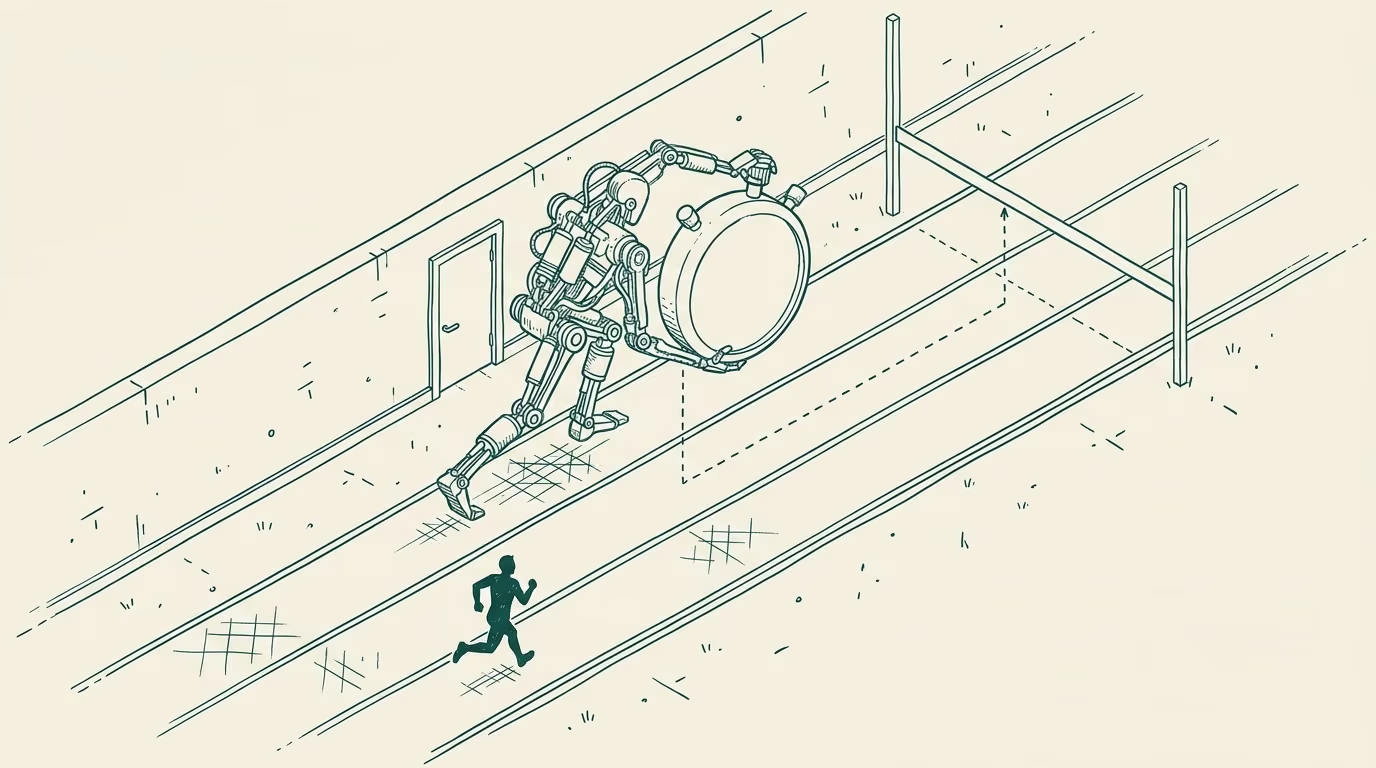
Levent Alpöge proposed the collaboration in September 2025. For about a year after that, he and Tristan Buckmaster, a mathematician at NYU, worked a line of attack on blow-up in the equations that describe how fluids move, and a lot of that work happened inside AI tools. Buckmaster paid for ChatGPT and Claude out of his research funds, did much of his reasoning in OpenAI's Codex, and put the drafts of the whole project into it. He had also opted out of having his data used for training. On August 15, 2026, they had a result.
On September 1, by OpenAI's own account, the company started a push on the Millennium Prize problems, prompted by rumours that two of them had been solved. The rumours concerned Anthropic, which is where Alpöge works. A week later OpenAI announced that an internal system of roughly 10,000 agents, running for 88 hours, had proved that a smoothly forced fluid starting at rest can develop a singularity in finite time.
Buckmaster had posted his own papers about twelve hours earlier, with a statement. It describes a call on September 6 in which OpenAI's Sébastien Bubeck "twice asserted that he wanted Levent removed from authorship", because Alpöge works at Anthropic, and in which Buckmaster, after saying he would go public, heard "Why would you ruin your career?" Bubeck disputes the account and has apologised for his wording. OpenAI says its researchers and its agents "did not see any of their work through any means until they released it publicly."
I do not know who is right. Nobody outside the two parties does, and nothing below depends on it.
The title promises a lawsuit
There isn't one. Nothing in the public record is a legal filing, and that absence is the story.
Intellectual-property law protects things you can point to. An expression, an invention you can file, a secret you can show somebody took. What Buckmaster had was a direction of attack on a problem, most of it sitting in a vendor's session logs. If any of it travelled, it travelled as a rumour, as a training signal, or as a hunch inside another team, and the only records that could say which are held by the company he suspects.
So the fight is being conducted with the instruments that exist. On his side, a PDF, a Mastodon post and a newspaper interview. On the other, a blog post that has been revised, a spokesperson, and a tweet. The researchers put their unpublished work into a competitor's tool, and the one instrument they had for governing what happened to it did not answer the question.
Four answers in five days
Buckmaster did what every privacy page tells you to do. He opted out.
On September 8, OpenAI's announcement still said this: "While unlikely, we cannot rule out that de-identified data derived from their usage of our products helped improve our models." On the evening of the 9th, a spokesperson told the New York Times it was "impossible for Dr. Buckmaster's Codex prompts over the last two months to have influenced the system in any way, including training." On the 10th, an updated release said an investigation had confirmed it. On the 13th, to the Washington Post: "After investigating, we can say with full confidence that no user inputs past July 3rd could have influenced this system in any way."
Read in order, the sequence is almost elegant. Each statement is more confident than the last, and each one is drawn around a date. The date is chosen by the company, investigated by the company, and announced by the company, which is also the only party that can see what sits on either side of it. The collaboration began in September 2025. By the final statement's own terms, roughly ten of its twelve months fall on the side of the line about which nothing has been said. Maybe nothing is there. Probably nothing is there.
Buckmaster's answer to the Post was five words. "I just don't believe them." He does not have to be right for that to be the only move available to him. The Next Web put the general case plainly: for a researcher using a frontier lab's tools on unpublished results, "the answer depends on believing the lab."
Take them entirely at their word
Suppose OpenAI is right about every particular. Its proof differs significantly from theirs, as it says. No agent touched a Codex session, no training run saw a draft. The information travelled the way it has always travelled in mathematics, as gossip, and Alpöge was chasing tips that his work had leaked before OpenAI ever called.
Then what happened is this. A company that sells a tool to a customer heard the customer was close to something, and within a week pointed ten thousand agents and millions of dollars of compute at the customer's problem. That is legal. It may even have been good for mathematics; the Clay Institute says the problem has "apparently been settled" and is being deliberately unhurried about credit. Buckmaster put the remaining question in one line to the Post: "Is it ethical for the AI companies to scoop their customers?"
The exposure is identical under both stories. If OpenAI did nothing, Buckmaster cannot demonstrate it, and neither could you. If it did something, no contract he held would have told him. The opt-out governed one question, training, and even that one took the vendor five days and four statements to answer.
The same seat, with fewer lawyers
Now take the mathematician out and put an operator in. A health system pasting an unshipped care pathway into a coding agent so it can wire it into the scheduling system. An airline modelling route economics for a market it has not announced. A founder debugging a product nobody has seen yet. Most of them ticked the opt-out too, probably, and most of them are using a tool built by a company with a research division, a product roadmap and a demonstrated appetite for adjacent markets.
That is what the maths case exposes. Vertical integration at the tooling layer makes your supplier a participant in your market. In July the surprise was a vendor's refusal policy that a customer discovered in the middle of a breach. This time it is the vendor's research posture, discovered in the middle of a race. A customer inevitably learns what the terms meant on the day the terms finally matter.
And Buckmaster had advantages the regional health system does not. He works in a field where twenty-six Fields medalists had signed an open letter about AI in mathematics within three days of the announcement, and TechCrunch, Fortune, the Times and the Post were all writing about him inside a week. The health system has a procurement contract and an account manager.
I am not writing this from the outside. Much if not most of the work I do every day leverages AI at every step. If a lab published my idea a week before I did, however loosely connected to my drafts and thoughts, my position would be Buckmaster's with far lower stakes. I could ask. I would get a statement.
The useful question for a vendor was never whether it trains on your data, because a toggle answers that. It is whether the vendor competes in your field, who inside it can see your sessions, and what it could show you, and when, if you thought it had used them. The Navier-Stokes week asked all three, and every answer arrived as a press statement.
The opt-out answers a question about training. The question Buckmaster ended up asking was who else is in the race, and the only party that can answer it is the other runner.
—TJ