Zitron called it 'subprime AI'. File the receipt.
TL;DR [show]
Industry analyst Zitron published the most-circulated bear case on generative AI: pricing unsustainably below cost across the OpenAI/Anthropic/Salesforce stack and an 'Agentforce-class' pricing cliff. Operator read: don't argue the bear case; file the article, watch the line items, and budget the cliff into your 2026 vendor-renewal model.
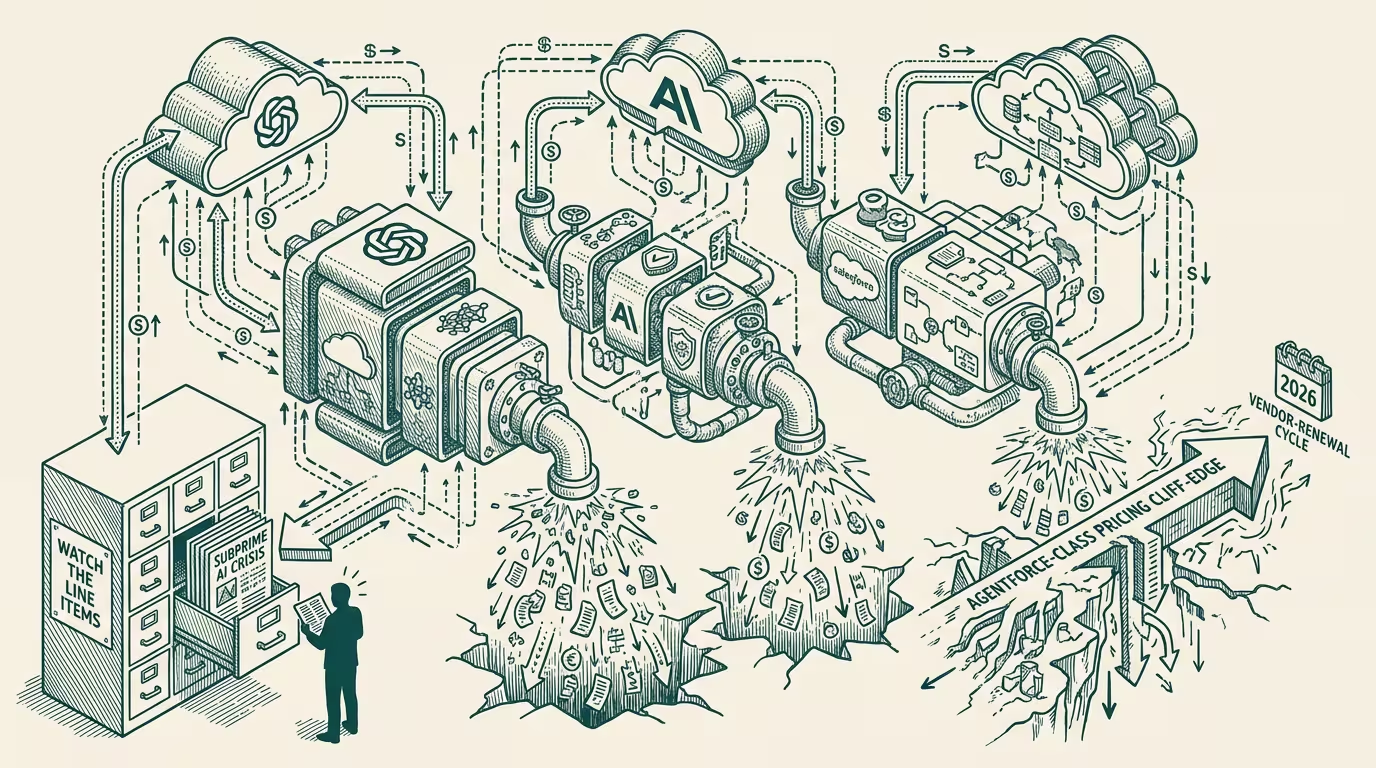
Ed Zitron published "The Subprime AI Crisis" in September 2024. The argument: AI vendors are pricing their products below the cost of serving them, the unit economics across OpenAI, Anthropic, and Salesforce's Agentforce are structurally unsustainable, and the operating mode is heading for an "Agentforce-class" pricing cliff when the vendors realize their gross margins do not exist.
The trade press wrote it up as the most-circulated bear case on the AI category since the Goldman Covello brief from June. The piece traveled. Zitron is a careful analyst with a long record of calling overhyped categories before the trade press caught up. The argument is, on the available data, structurally defensible.
What does the part that holds say? Don't argue with Zitron. File the article. Watch the line items. Budget the cliff into your 2026 vendor-renewal model.
What's actually happening with vendor pricing? It's an artifact of market-share-grab, not steady-state economics. OpenAI's per-token pricing, Anthropic's per-token pricing, Salesforce's per-conversation Agentforce pricing — all three are calibrated for adoption velocity. None of them are calibrated for unit economics. The vendor that runs at adoption-pricing for too long discovers, in the renewal cycle, that the customer has built workflows against a price that the vendor cannot sustain. The customer renewal at 2x the original price loses some fraction of the customer base. The customer renewal at 5x loses most of it. Zitron's "Agentforce-class cliff" is the gap between adoption-pricing and steady-state-pricing, and the vendor's commercial structure determines whether the cliff is 2x or 5x.
What's the customer's defense against the cliff? Contractual. A multi-year vendor contract signed at adoption-pricing in 2024-2025, with a price-floor clause that protects the customer through 2027-2028, is the contract that hedges the cliff. The customer that signs a one-year renewable contract at adoption-pricing is the customer that gets the cliff at full impact. The vendor's salesperson is, of course, motivated to sell the one-year. The customer's procurement officer should be motivated to sign the multi-year. Most procurement officers in 2024 are not yet pricing this risk because the adoption-pricing feels like the steady-state pricing. By 2026 they'll know better.
Does the bear case being right mean the AI category is dying? No. Zitron's argument is that the current pricing is unsustainable. That is true. The category survives the pricing reset and continues compounding on a higher base of unit economics. The vendors that survive the cliff are the vendors with margin-positive workflows, sticky customer bases, and contractual leverage. The vendors that don't survive the cliff are the vendors whose product was structurally a marketing-pilot priced as production. Zitron's frame helps the operator distinguish which vendors are which.
What's the operator-class playbook? Don't argue the bear case. The bear case is structurally well-formed, and arguing with it produces the same kind of meeting-loss the Covello rebuttal-class debates produce. File the receipt. Watch your AI-vendor invoices for unusual line-item growth that suggests cost-pass-through is starting. Lock multi-year contracts at adoption-pricing where you can. Budget your 2026 renewals against a 2-3x price increase as the modeled scenario, and a 5x increase as the worst case.
The vendors who fumble the cliff are, of course, going to write the announcement up as a "pricing optimization" that "rationalizes the platform's economics." The customers who hedged will read the announcement on a contract that doesn't apply to them yet. The customers who didn't hedge will pay the difference between the announcement and the renewal.
Zitron called it 'subprime AI'. File the receipt.
—TJ