Equity is pricing a monopoly. Credit is pricing a tenant.
TL;DR [show]
On October 30, 2026 the Financial Times reported that Blackstone, anchor investor in the $63 billion financing of Anthropic's chips, had told its co-investors to expect a double-B junk rating after the IPO, having previously expected investment grade before 2027. On November 2 Anthropic's amended prospectus showed roughly $17 billion of third-quarter revenue, growth of 47% after 144% and 132%, and about $895.4 billion of purchase and lease commitments, substantially all for compute and infrastructure. The piece tests the June claim that a lab financed like a utility gets governed like one: the obligations are utility-sized, but a utility borrows cheaply because its customers cannot leave, and a lab's can. Equity is pricing a monopoly, credit is pricing a tenant, and the difference lands on the four suppliers that are also its investors, customers and landlords.
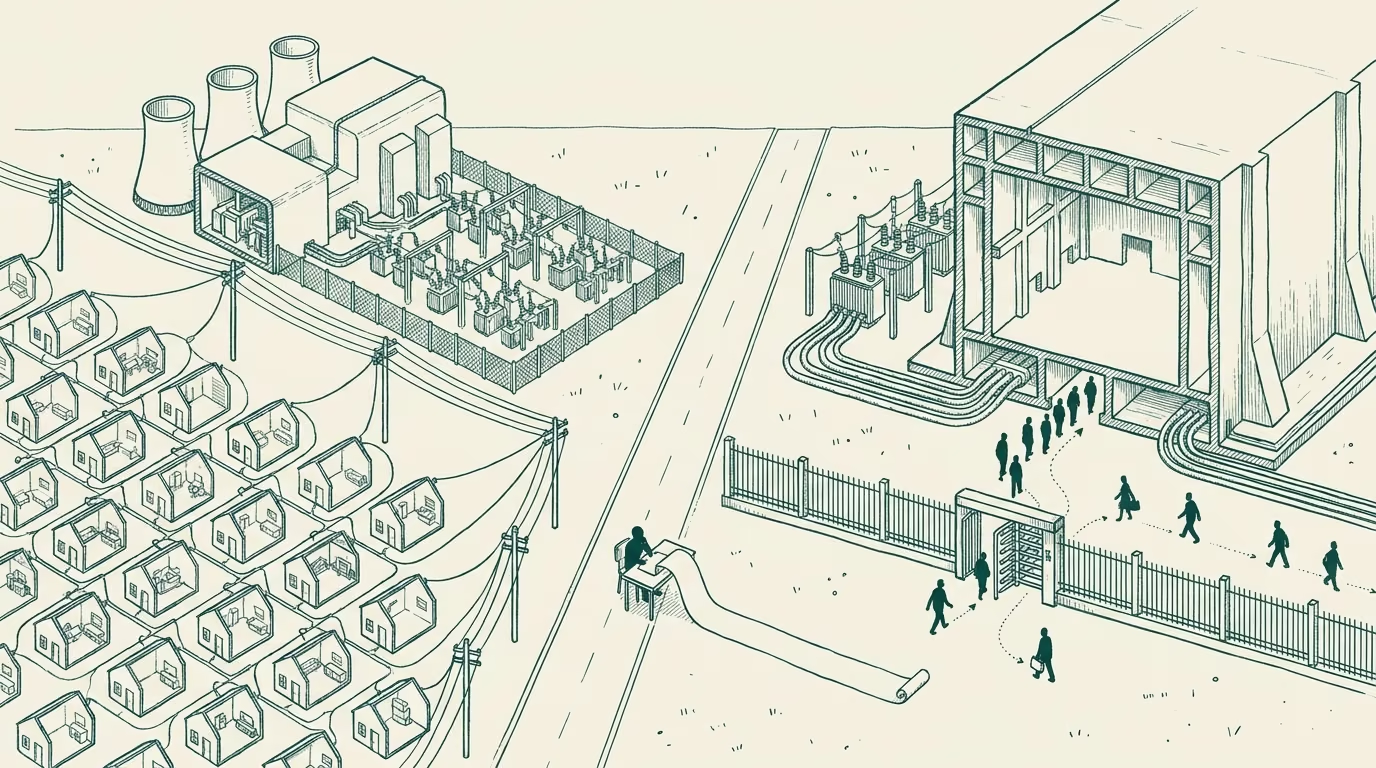
In June I wrote that the labs had filed to become utilities, and that a lab financed like a utility gets governed like one. The financing half has held. The chips are leveraged against long contracts, the IPO is the equity tranche, and the credit desks are still writing. The governing half got its first independent grade on Friday, October 30, and the grade is junk.
Blackstone anchored the $63B deal that finances Anthropic's chips. Per the Financial Times, it has told the other investors in that deal to expect a "high" junk rating after the IPO: double-B, the top of the speculative pile. Until recently it expected investment grade before 2027. Anthropic and Blackstone declined to comment, and Blackstone's view is a forecast, not an agency opinion. But the anchor lender of the sector's largest chip financing telling its co-investors what the paper will be worth is not gossip. It is the lender marking its own book.
Then the numbers arrived. On Monday, November 2, Anthropic amended its prospectus: revenue of roughly $17B in the third quarter, growth of 47% on the quarter after 144% and 132% in the two before it, and about $895.4B of purchase and lease commitments, "substantially all of which is related to compute and infrastructure." That is fifty-three quarters like the last one, committed. Compute expense alone rose $14.4B over nine months, up 329%. (The $104B nine-month loss is mostly a fair-value change on convertible notes, an accounting figure, and I will leave it there.)
A utility's bills, then, and a tenant's rating. The combination is not supposed to exist.
A utility borrows cheaply because of one fact about its customers: they cannot leave. The ratepayers are on the wire, the regulator sets the return, and a bondholder can lend thirty years against revenue that is as close to guaranteed as private money gets. Nobody lends against the size of a bill. They lend against who is stuck paying it. A lab has the bills of a utility, the chips and the power and the leases and the multi-year offtake, and it has the customers of a software company. They are on a monthly plan. They can be gone by the first of the month, and Anthropic spent October explaining that some of its larger customers had been rivals buying a copy on their way out.
Equity read the filings as a monopoly in the making and priced one. Credit read the same filings and priced a tenant. Both looked at the same $895B. One saw an asset base. The other saw a lease.
The credit read is climbing the stack. Oracle, which leases the labs their data centres, filed on the same Monday to raise $20B, half in stock and half in senior notes, on top of $125B of debt and an S&P rating of BBB-, which CNBC glossed as "one rating level above high yield". The landlord is a notch above junk; the tenant is expected a notch below. Alphabet, which sells Anthropic compute and owns a piece of it, reported its second straight quarter of negative free cash flow, about $9B out the door on $51B of capital spending, and gave up about 12% of its value in a day. Lee Hepner, writing for Matt Stoller's BIG, took the S-1's own warning that Amazon, Google and Microsoft are "investors, customers, distribution partners, and competitors" at once, added Broadcom as supplier and lessor, and called Anthropic "four monopolies in a trench coat." Google's unrealized gain on its stake is $117B. So the suppliers are the shareholders are the customers are the lenders, and a tenant's rating does not stay with the tenant. It lands, with a lag, on four balance sheets that were rated as landlords.
My June read gives on one point. I argued the financing structure would become the strategy, that debt service would decide what a lab is allowed to build, and it still will. What I missed is that the market had not settled who carries the structure. A utility's bondholders carry it and are paid for the tedium. A tenant's commitments are carried by whoever signed the other side of the lease, which, in Nvidia's case, is a footnote that names one tenant. At $895B against $17B a quarter, with growth already down to 47%, the question of who holds the paper when growth halves again is not a question for 2035. It gets priced on the roadshow, which reportedly opens the week of November 9.
My money is with the credit desk, for a dull reason. Lenders are paid back first, so they are the people who bothered to read the lease. Equity bought a story in which the customers eventually cannot leave. That story may even come true. But a company its customers cannot leave is the thing we regulate, and the regulator inevitably shows up for it. The investment-grade rating arrives the day the customers are stuck, and so does the rate case. A lab gets both or neither. Not one.
—TJ