A bond, a power bill, and a phone are paying for the same data center.
TL;DR [show]
The cost of the AI buildout is not hidden and it is not being absorbed by the people making the bet. It is being paid through three instruments held by three different populations: debt (Tomasz Tunguz estimates roughly $4T of issuance over five years, equal to 91% of the US municipal bond market, with facility-level leverage of 65 to 75 percent and up to 90 percent in synthetic JV SPVs, requiring AI revenue of $1.2T to $1.5T by 2030 against $100B to $200B annualised today, a 55 percent CAGR); electricity (PJM capacity clearing at $28.92 per megawatt-day in the 2023 auction, $269.92 the next year and $333 by December 2025, with the auction total moving from $2.2B to nearly $14.7B, Duquesne Light's default rate up about 15 percent and West Penn Power's up 9 percent, and PPL's March 2026 settlement creating a large-load rate class that contributes $11M to a low-income program whose universal service costs had until then been borne solely by residential customers); and component prices (AI server DRAM roughly doubling in Q1 2026 per Deloitte with a fourfold rise expected for the year, and IDC forecasting worldwide smartphone shipments down 16.7 percent in 2026 to just over a billion units at an average selling price up 27.6 percent to $581, with the sub-$100 tier down almost 60 percent year over year). The argument is incidence rather than financing: each public argues locally, in its own regulator's vocabulary, and the locality of the argument is what keeps the aggregate from ever being priced. The Alberta case opens the piece because it is the cleanest single instance: Pembina's analysis of Meta's $13B Sturgeon County facility finds $270 to $460 a year added to a typical Albertan's bill between 2027 and 2031, because the building draws from the grid in the gap between switching on and its own 932 MW plant running in the second half of 2030, and Meta rejects the finding on the grounds that it pays every invoice addressed to it. Explicitly not a claim that the three channels started at once: they run from 2023, from Q1 2026, and from a five-year forecast, and only the coverage is simultaneous.
Meta's data center in Sturgeon County, just north of Edmonton, is a $13B building that will switch on before its own power plant does. Capital Power is contracted to supply 250 megawatts starting in the second half of 2028. The Greenlight Electricity Centre, the 932-megawatt plant being built on the site to run the thing, is not due to operate until the second half of 2030. In the years between, the building draws from the Alberta grid like every other customer on it, except at hyperscale.
The Pembina Institute did the arithmetic on what that does to everyone else's bill and came back with $270 to $460 a year added to a typical Albertan's power bill between 2027 and 2031. Pembina is a clean-energy advocacy institute and discloses who funds it. Few of the numbers in this argument come with that attached. It also finds Albertans getting about 6% back on the transmission portion from the connection itself, and says the market effect swamps it.
Meta rejects the finding. A spokesperson says the company pays the full cost of the energy upgrades and the electricity its Sturgeon County facility uses, and that none of it gets passed to Albertans.
Both of those can be true. Meta can pay every invoice addressed to Meta, in full, on time, and a tighter supply pool can still reprice the hours everybody else is buying. Nobody has to be lying. The cost arrives somewhere that nobody sends an invoice, and the two statements never meet.
Three instruments, three publics
I would have left that as an Alberta story except that I spent the same week reading two other numbers that have nothing to do with Alberta and nothing to do with each other. A debt forecast. A capacity auction. The price of memory.
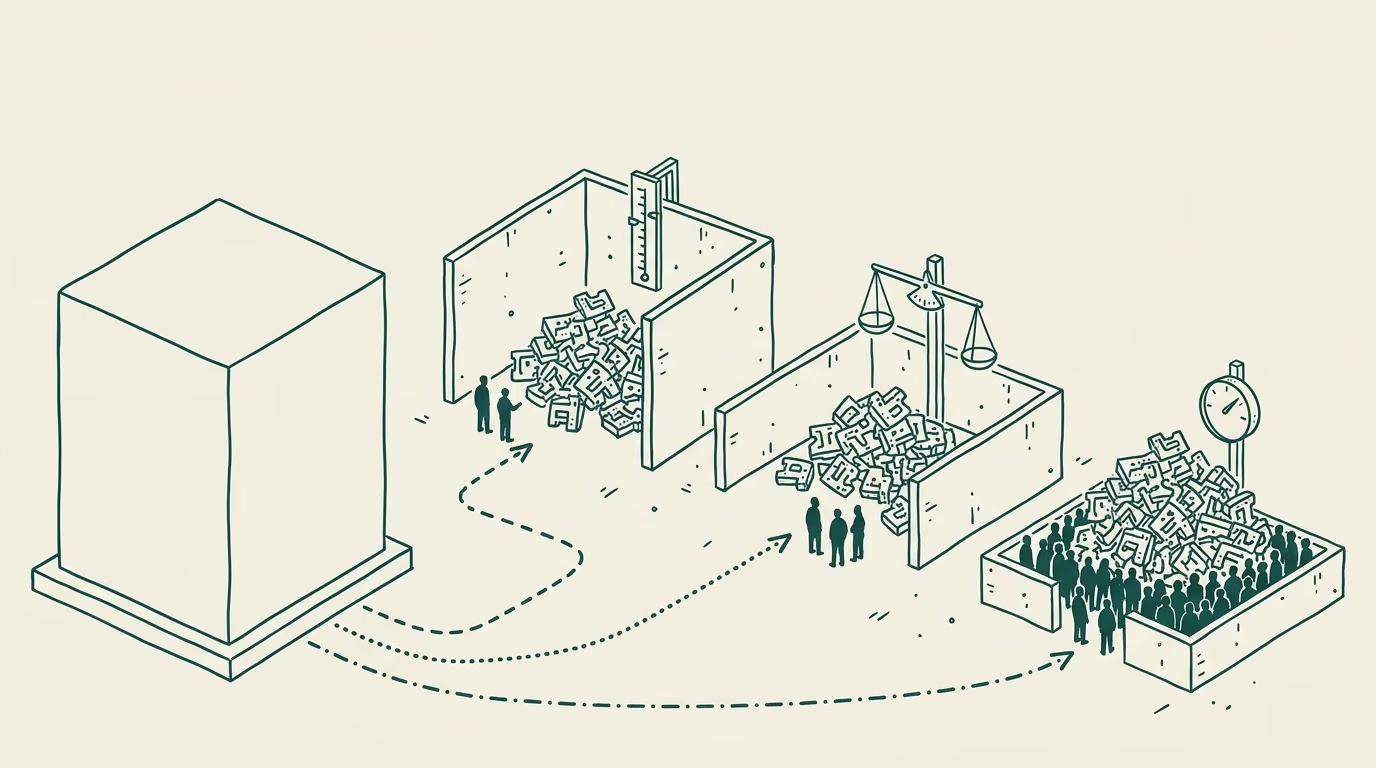
Put next to each other, those are not three stories about the AI buildout. They are three instruments carrying the cost of the same buildout, and each one is held by a different population.
Which is a narrower claim than the usual one. The usual argument is about financing, whether the buildout can be paid for, whether the revenue arrives, whether the whole thing is a bubble with a substation attached. I have written about how the buildout gets paid for and about vendor financing running in a circle. This one asks who pays, in what currency, and whether anybody ever sees the total.
The bond
Tomasz Tunguz sized the debt side on 4 September. Hyperscalers and data center operators, roughly $4T of issuance across five years. He is a venture capitalist writing about an asset class he invests around, and he says so himself in the flattest possible way, "As a venture capitalist, I have a naive view of the bond market." Take it as an estimate from an interested party who told you he was one.
That issuance triples the outstanding commercial paper market. It grows larger than global private credit. And it equals 91% of the US municipal bond market.
The muni market is how a county builds a water treatment plant, how a school district replaces a roof, how a transit authority buys buses. It is the instrument through which American local government turns a public need into a bond somebody's pension fund holds. Over five years the compute buildout proposes to issue paper approaching the size of that entire market, into the same universe of buyers.
The leverage underneath it is not conservative. Tunguz has facility-level debt routinely at 65% to 75%, and up to 90% inside synthetic joint-venture vehicles, of which the one he names is Meta's Beignet.
Same company as the building in Sturgeon County. Not that Beignet finances it, and I have no evidence it does, but a hyperscaler is one balance sheet appearing in two places at once, holding a 90%-levered vehicle on one side and telling an Alberta reporter it pays its own power bill on the other, and both of those sentences are being audited by people who will never read the other one.
Then the servicing arithmetic. Annual AI revenue has to exceed $1.2T to $1.5T by 2030, against $100B to $200B annualised across every cloud provider and model lab today. Getting from roughly $150B to roughly $1.35T in five years is a 55% compound growth rate, sustained, for half a decade.
Set aside whether that happens. Ask who holds the paper if it does not. Facility-level debt at 75% is not held by the hyperscaler's equity holders. It is held by credit funds, insurers and pensions, by people who bought a bond rather than anyone who made a bet on artificial intelligence.
The power bill
The second instrument does not look like a financial instrument at all.
In PJM's capacity market, the auction that pays generators to be available, the price for the 2025-26 delivery year cleared at $28.92 per megawatt-day in the 2023 auction. The next auction cleared at $269.92. By December 2025 it reached $333. As totals rather than rates, an auction that cost $2.2B one year cost nearly $14.7B the next. Those costs pass through. Duquesne Light's default rate went up about 15%, West Penn Power's about 9%.
Capacity prices have several drivers and a fight about attribution attached to each of them. Nobody argues about the shape of the pass-through, though. It lands on every retail customer in the territory, in proportion to nothing except how much electricity they happened to use.
In March 2026 PPL Electric settled a rate case that created something new, a separate customer class for large-load data centers, on different rules from everybody else, contributing $11M toward the residential low-income program. First time a Pennsylvania utility required that of large loads. Susan Phillips, reporting it, included the sentence the settlement turns on. Those universal service costs "have up until now been borne solely by residential customers in Pennsylvania."
So a capacity market repriced by roughly twelve billion dollars in a year, and a precedent-setting settlement moving eleven million of it. Both numbers are correct. Only one is the size of the problem.
I am going to leave out what voters in Pennsylvania think about this, because what they think is a receipt and the mechanism is what I am after. The mechanism is that the electricity cost of the buildout gets allocated by a body whose entire job is allocating electricity costs, using a vocabulary built for allocating electricity costs, in a proceeding where nobody is required to mention bonds.
The phone
The third instrument is the one nobody files a rate case about.
Deloitte, in July, had AI server DRAM roughly doubling in price during the first quarter of 2026, with a fourfold increase expected across the full year. Hyperscalers are projected to spend about 30% of their 2026 data center investment on memory alone, rising toward 36% in 2027. Memory is not a side component of an AI rack. It is roughly a quarter of the bill of materials, and the buildout is bidding for it against everything else memory goes into.
Everything else includes the cheapest phone in the world.
IDC's August forecast has worldwide smartphone shipments falling 16.7% in 2026, to just over a billion units, with the average selling price up 27.6% in a single year to $581. Then the split. iOS shipments are down 1.3%. Android is down 24.3%. And the segment under $100, which shipped 173 million units last year, fell almost 60% year over year in the second quarter.
Nobody decided that. There is no proceeding in which the sub-$100 phone tier was weighed against a training cluster and found less deserving. A component got scarce, a price went up, and the buyers with no room absorbed it by leaving the market. The person who can pay $581 for a phone is still buying a phone. The person who was going to spend $80 is not.
The cost of the buildout landed on them, and they have never heard the word hyperscaler.
Three rooms, three vocabularies
A bond, a utility tariff, a memory chip. Credit investors, retail ratepayers, low-end device buyers. A bond desk, a utility commission, a spot market for components.
None of the three venues has a mandate to look at the other two, and none of the three vocabularies can express the other two. A bond desk prices credit risk and cannot represent a Pennsylvania residential tariff. A utility commission allocates costs among the customers in front of it and has no standing to consider the price of DRAM. Each proceeding is run competently. Each is complete on its own terms.
They also did not happen at the same time, and that is the least story-shaped fact here. The capacity repricing runs from a 2023 auction. The memory squeeze is a Q1 2026 event still working through. The $4T is a five-year forecast about issuance that has mostly not happened yet. The only thing that clustered this month is the coverage. Had the three arrived together, as one shock, somebody would have added them up, because a single event with three consequences gets a name and a commission and a number, whereas three separate events with one cause get three separate arguments, each won or lost locally, by people who never meet.
The locality of the argument is what keeps the aggregate from ever being priced.
The obvious objection is that this describes every piece of infrastructure ever built. Railways were financed on paper somebody else held, and the grid itself socialised its own buildout across a century of ratepayers who never voted on it. True, and the comparison is worth making, because it points at what is different rather than at what is the same. Those buildouts had a regulator whose remit covered the whole thing. A state railway commission priced the route, the return and the fare in one proceeding. What has changed is not that the cost is dispersed. It is that the dispersal now crosses three regulatory perimeters that were each drawn before any of them had a reason to look at the others. Securities disclosure, a state utility commission, and for the third one nothing at all.
The grid produces both
Six days ago I wrote about companies putting the compute behind the meter, siting inference next to generation that already exists, including inside houses. In one of those pilots a homeowner gets roughly $1,800 a year off power and internet for hosting a rack.
Hold that against Alberta, in the same unit. A household hosting compute, about $1,800 a year in its favour. A household on Sturgeon County's grid, up to $460 a year against. Neither one pays the other. The mechanisms are unrelated and the geographies are two thousand kilometres apart, and the two numbers are the same size because they come off the same buildout.
The bond gets a prospectus. The tariff gets a docket number, a comment period, and a settlement somebody will cite for years. The phone gets nothing. No filing, no party of record, no finding to appeal. The 173 million units the sub-$100 tier shipped last year are not a constituency in any proceeding anywhere.
There is no unit that holds all three. A bond is priced in basis points, a tariff in dollars per megawatt-day, a phone in what somebody was going to spend and then didn't. So the total does not exist. Not because anybody suppressed it, but because there is no room in which it would be a legitimate question.
The buildout gets paid for either way. It already is being, on time and in full, across three ledgers. Two of them have a room and a vocabulary. The third has somebody who went to buy an $80 phone, found the price had moved, and went home.
—TJ