When the grid stops growing, the frontier leaves the planet.
TL;DR [show]
On June 12 SpaceX priced the largest IPO in history at $1.77 trillion, and almost everyone described it as a rocket company. Four days earlier, at Bastrop, it showed the AI-1 satellite and a target of one terawatt of orbital AI compute by 2027-28. I have argued the energy-sovereignty thesis at three scales this month: the nation, the lab, the balance sheet. I missed the fourth. The binding constraint on frontier AI is energy, terrestrial power is barely growing outside China, and the only company that can manufacture the chip, launch the mass, harvest the sunlight, and rent the result to the labs trying to beat it has just turned that loop into the largest pool of public capital ever raised. xAI's edge was never Grok. It is being the captive tenant of the only landlord that can leave the planet. Musk is wrong on the timeline and right on the direction, the same way I was.
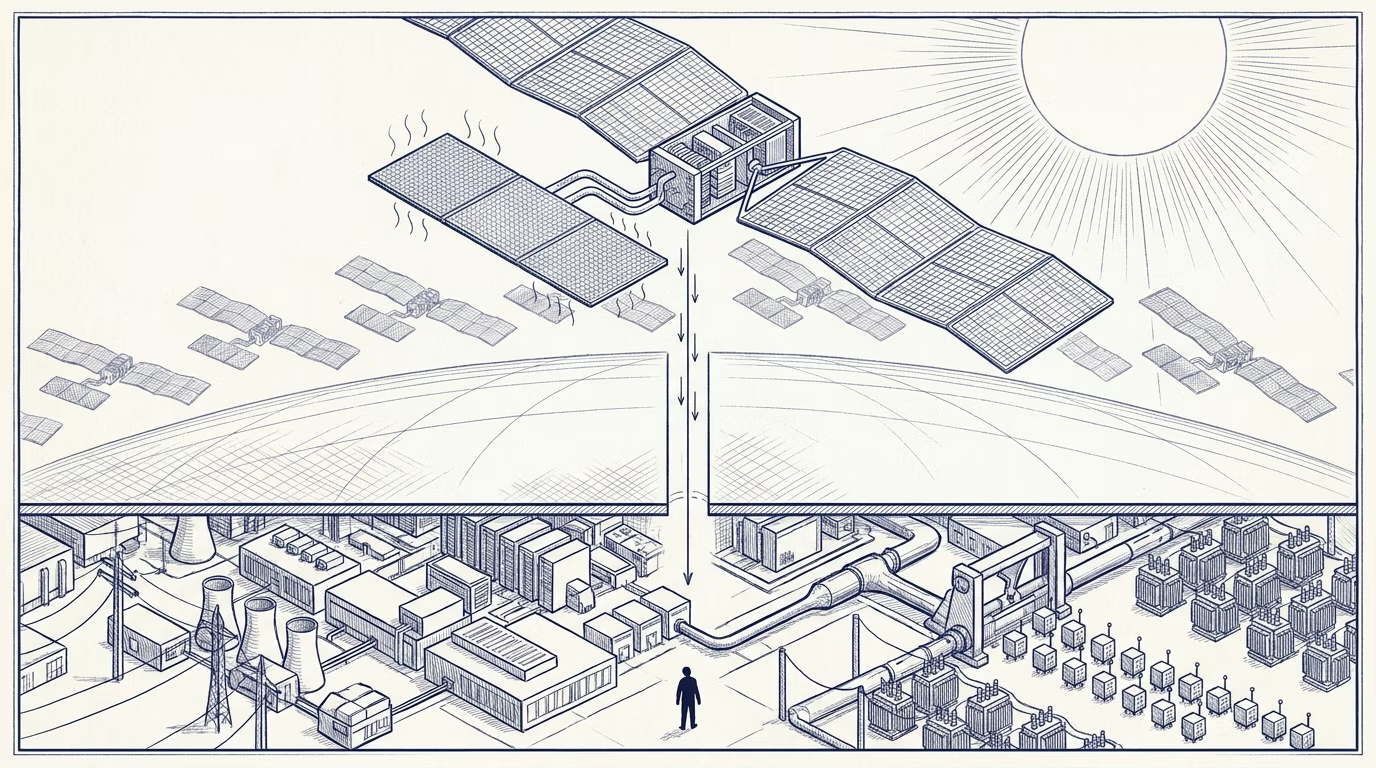
On June 12 the largest IPO in history priced, and almost everyone described the wrong company.
The coverage said rockets. It said Starlink, which is fair, because Starlink is the only part of SpaceX that actually makes money and it carried most of the $1.77 trillion the market handed back on the first day. It said Musk consolidates control, also fair, since the dual-class structure left him 85% of the votes and the public a one-vote souvenir. What almost nobody said is that the prospectus, underneath all the satellites, is an energy document. And four days before it priced, at a campus in Bastrop, Texas, Musk and a Starlink engineer named Ian Dahl stood in front of a slide and told you exactly what kind.
The slide was a satellite called AI-1. About 150 kilowatts of peak power, 120 sustained, which is roughly one rack of Nvidia's newest accelerators. A solar array seventy meters across. Double-sided deployable radiators rejecting waste heat at 1,400 watts per square meter, because in vacuum there is no air to carry heat away and the only way to cool a computer is to glow. One satellite is a rack. The stated target is a terawatt of compute in orbit by 2027 or 2028, which on their own arithmetic means putting something like ten million tons of payload into space every year. There is an FCC filing from January for a constellation of up to a million satellites. None of this was in the IPO headlines. All of it was in the IPO.
I should have seen it coming, because I have spent the entire month making the same argument one altitude too low.
I wrote that there is no AI sovereignty without energy sovereignty, and I made the case at the scale of a country: put power generation behind the meter, on every roof, before the grid you depend on becomes a leash someone else holds (the New Canadian Dream). Then the labs proved the same point at their own scale, renting each other's power plants because megawatts, not chips and not money, had quietly become the thing nobody could build fast enough (labs started renting each other's power). Then the financing layer arrived, and the labs began filing to become utilities, because the only entities that can underwrite twenty gigawatts for a decade are the ones structured like power companies in the first place (the labs filed to become utilities). Nation, lab, balance sheet. Three scales of one idea. I thought I had the whole stack.
I missed the top of it. The ceiling has an exit, and the exit is up.
Here is the argument in Musk's own framing, which for once I do not think is hyperbole. The bottleneck on AI is energy. Terrestrial power generation is barely growing anywhere outside China, and AI demand is growing on a curve that does not care. You can fight that on the ground, behind the meter, with gas turbines and islanded microgrids and a decade of permitting fights, which is the war everyone is currently in. Or you go to where the power already is and nobody is standing in line for it. In low Earth orbit the sun never sets on the right inclination, the panels never ice over, there is no interconnection queue, no county zoning board, no water table to drain for cooling. The energy is free and constant and it has been there the whole time. The hard parts are getting mass up and getting heat out, and those are the two problems SpaceX has spent twenty years turning into a cost curve.
None of this is as exotic as it sounds, because the frontier has always followed the power and never the other way around. The mill went to the river because that is where the work was. The factory went to the coalfield, then the oilfield, then wherever the grid reached cheap. For the last decade compute has done exactly the same thing, just with less poetry about it: bitcoin miners parked at the foot of hydro dams, hyperscalers chasing stranded gas in west Texas and cheap geothermal in Iceland, the whole behind-the-meter scramble I keep writing about. Compute has been a migratory animal hunting cheap energy the entire time. Orbit is not a new instinct. It is the old instinct with the ceiling taken off, the one watering hole the herd can reach that is infinite and unowned and never freezes over. The only reason it sounds like science fiction is that until the launch cost came down the door was welded shut, and the company that spent twenty years cutting that door open is the one that just went public.
That is the thing the rocket framing misses. SpaceX is the only company on earth that can close the entire loop. There is a chip fab now, Terafab, a joint venture with Tesla and xAI in Austin. There is the only launch system with a credible path to cheap mass-to-orbit. There is the satellite that harvests the power. There is the model, Grok, that runs on it. Chip, launch, power, compute, model, all under one roof, which happens also to be the roof of the largest IPO ever floated. You do not raise seventy-five billion dollars to sell internet. You raise it to be the landlord of the next energy frontier the way the utilities are becoming the landlords of this one.
Which is the part that actually answers the question I kept getting asked this week: what does any of this mean for xAI?
It means the merger was never about Grok. When SpaceX absorbed xAI in February and folded it into a unit this spring, the read in the press was that Musk was rescuing a money-losing lab by bolting it to a cash machine, and the prospectus does show xAI as most of the reason SpaceX lost five billion dollars last year. But that gets the direction of the favor backwards. xAI's durable advantage was never going to be model quality. The frontier is a four-way street and Grok is one lane of it. xAI's advantage is that it is the captive tenant of the only landlord with a path off the terrestrial power ceiling. The other labs see this clearly, which is why Anthropic, while renting all of Colossus 1 on the ground for $1.25 billion a month, also quietly asked SpaceX about building multiple gigawatts of compute in space. Your rivals do not ask you to build their next power plant unless they have concluded you are going to own the only site that scales. The frontier race, underneath the model benchmarks everyone argues about, is becoming a launch-cadence-and-orbital-power race, and exactly one company can run that race.
Now let me be the operator in the room instead of the fan, because the timeline is a fantasy and I want to say so plainly.
A terawatt in orbit by 2028 is not happening. The radiator math alone breaks it: rejecting gigawatts of heat at 1,400 watts per square meter means deployable structures the size of city blocks, flown thousands of times, surviving thermal cycling and micrometeorites and the slow cook of radiation, and we have flown exactly one of them as a test. Ten million tons to orbit a year is more than a hundred times what the entire human race launched last year, on a vehicle that is still exploding on the pad often enough to make the number a wish. I have watched enough hardware timelines from enough confident founders to know the shape of this one. It will slip. It will slip by years, and the first real orbital data center will be a rounding error next to the press release, and the skeptics writing today that the physics does not pencil will get to be right for a while.
And they will be right about the timeline and wrong about the direction, which is the only kind of wrong that matters, and it is exactly the mistake I made. Yesterday I caught myself having called the rich-agent divide for 2027 and watched it land a year early, and I had to write the correction: right about the shape, wrong about the clock. This is the same lesson pointed the other way. The clock here is slower than Musk says and the direction is more certain than the skeptics admit. When terrestrial power stops growing and compute demand does not, compute migrates to where the power is, and the only place with more power than Earth and no one in line for it is the same place the sun has been pouring it out, uncollected, for four billion years. That migration is not a question of whether. It is a question of who owns the launch.
And this is the part that should end the "one billionaire's vanity" reading for good: he is not alone up there. Google has a program called Suncatcher, solar-powered satellites carrying its own chips, and Sundar Pichai has said on the record that the first step happens in 2027. A startup called Starcloud has already run an Nvidia chip in orbit and is selling a five-gigawatt design on the promise of energy ten times cheaper than the ground. When the second-largest company in the world and a seed-stage startup and the largest IPO in history are all pointed at the same patch of sky, it is no longer a stunt. It is a consensus forming in real time, and the only open argument is about the date.
So here is where I have landed, with the whole stack finally in view. Terrestrial energy sovereignty and orbital energy sovereignty are not two stories. They are one story told at two altitudes. The country that buys its power from a hostile neighbor gets pushed around the table. The lab that rents its compute from a rival gets pushed around the same table. And the civilization that runs out of room to make power on the ground does not stop computing. It looks up, at the one source that never sent an invoice, and it starts building toward it, slowly and over budget and inevitably. The grid stopped growing. The frontier is going to leave the planet to find more of it. SpaceX just sold tickets.
—TJ